Navigating the transition from the U.S. Juris Doctor (JD) model to international legal frameworks is often described by students as “learning to think all over again.” As of the 2026 admission cycle, the Law School Admission Council (LSAC) reported a 33% surge in law school applicants, many of whom are increasingly drawn to global and comparative law to stay competitive in a borderless legal market.
However, the leap from the Socratic method and the U.S. Constitution to foreign jurisdictions—particularly the UK’s uncodified system—presents unique academic friction. Whether you are analyzing Transatlantic trade laws or human rights frameworks, the “cognitive lock-in” of American legal training can hinder your grades if not addressed early.
Below, we break down the five most common hurdles US students face in comparative law and provide data-driven solutions to overcome them.
1. The “Uncodified” Confusion: UK vs. US Constitutionalism
For a US student, the Constitution is the “Supreme Law of the Land.” In comparative courses involving the United Kingdom, the absence of a single, written constitutional document is the first major roadblock.
- The Hurdle: US students often struggle with the concept of Parliamentary Sovereignty. In the US, courts can strike down legislation; in the UK, Parliament is theoretically supreme. This requires a shift from “constitutional interpretation” to “statutory interpretation” and understanding the “conventions” that govern the state.
- The Solution: Focus on the Human Rights Act 1998 and the UK Supreme Court’s evolving role. Treat the UK system as a “political constitution” rather than a “legal” one.
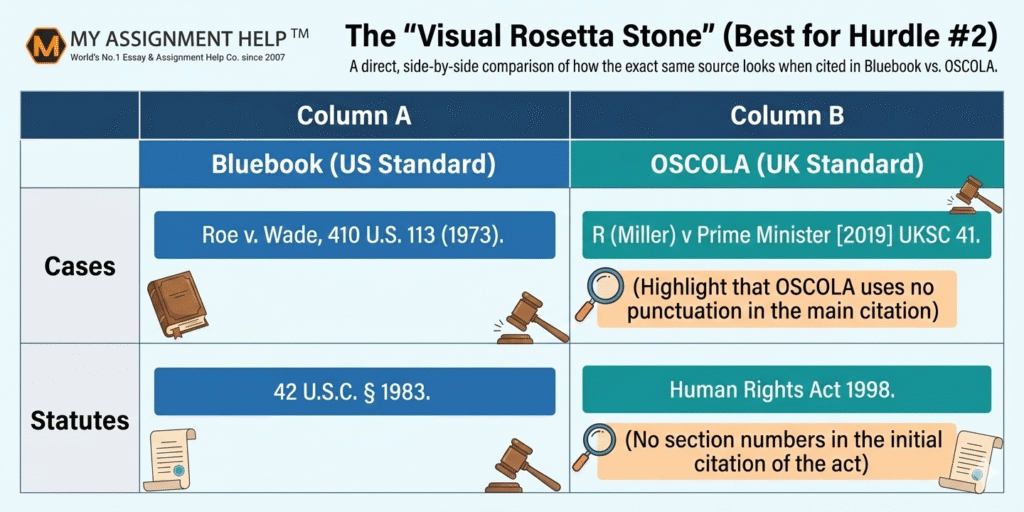
2. OSCOLA vs. Bluebook: The Citation Citation Trap
The Bluebook is the bible of American legal citation. However, international and UK-based comparative courses almost exclusively demand OSCOLA (Oxford University Standard for the Citation of Legal Authorities).
- The Hurdle: Small differences—like the placement of punctuation in footnotes or the use of neutral citations—can lead to significant point deductions. Research indicates that formatting errors account for up to 10-15% of grade variance in postgraduate law assignments.
- The Solution: Use dedicated assignment help websites to review your footnotes. Professional editors can ensure your transition from Bluebook to OSCOLA is seamless, preventing “easy” marks from slipping away.
See also: Research Peptides: The Ultimate Powerful Guide to Benefits, Uses, and Science in 2026
3. Doctrinal Depth vs. Practical Socratic Reasoning
Recent 2026 research from the Social Science Review highlights a fundamental pedagogical divide: the UK model (LLB/LLM) is intensely academic, focusing on the “depth of doctrines,” while the US model (JD) prioritizes practical training and Socratic dialogue.
- The Hurdle: US students are trained to be “advocates” from day one, often prioritizing the application of law over its historical philosophy. In a comparative law essay, a lack of “jurisprudential” analysis (the ‘why’ behind the law) can make an essay feel “too descriptive” for UK-trained markers.
- The Solution: When tackling UK-based modules, ensure your analysis includes historical context. For those struggling to balance these two distinct writing styles, seeking specialized law assignment help can provide a template for “first-class” doctrinal writing that satisfies international professors.
4. The “Tertium Comparationis” Methodological Gap
In comparative law, you cannot just list differences; you must establish a Tertium Comparationis—the common denominator that makes comparison possible.
- The Hurdle: Many students make the mistake of “juxtaposing” laws (describing Law A, then Law B) without actual integration. This is a failure of comparative methodology.
- The Solution: Use the Functional Method. Instead of asking “What is the law on Torts?”, ask “How does this legal system solve the problem of accidental harm?” This shifts the focus from rules to solutions.
5. Over-Reliance on “American Exceptionalism” in Analysis
Comparative law requires what scholars call “cultural immersion”—the ability to view a legal system through its own cultural and socio-economic lens rather than judging it against US standards.
- The Hurdle: US students often criticize foreign systems for lacking a “Bill of Rights” or “Jury Trials” in certain contexts, failing to see the alternative protections (like the European Convention on Human Rights) that serve similar functions.
- The Solution: Practice “Legal Neutrality.” Use data-driven sources, such as the Thomson Reuters 2026 Legal Market Report, to understand the economic and regulatory drivers behind foreign legal shifts.
Comparison of US and UK Legal Education Models (2026 Data)
| Feature | US Model (Juris Doctor) | UK Model (LLB/LLM) |
| Primary Method | Socratic / Case Method | Doctrinal / Lecture-based |
| Standard Citation | Bluebook | OSCOLA |
| Focus Area | Practical Advocacy & Clinicals | Legal Philosophy & Doctrine |
| Entry Point | Postgraduate (after Bachelors) | Undergraduate or Postgraduate |
Key Takeaways
- Shift your Perspective: Don’t look for a “US-style” solution in a foreign system; look for the function the law serves.
- Master OSCOLA early: Citation errors are the most avoidable cause of low grades.
- Avoid Descriptive Writing: Analysis in comparative law requires comparing the “spirit” and “policy” of the law, not just the text.
- Establish a Common Ground: Always define your Tertium Comparationis in your introduction.
FAQ Section
Q1: Is a UK LLM recognized for the Bar Exam in the US?
A: It depends on the state. New York and California are generally more receptive to foreign-trained lawyers, but you usually need to ensure the LLM covers specific “Bar-required” subjects.
Q2: Why is OSCOLA so different from Bluebook?
A: OSCOLA is designed for the UK’s legal structure, which emphasizes neutral citations and lacks the volume/page number intensity of the US reporter system.
Q3: Can I use AI to write my comparative law essay?
A: Most law schools in 2026 have strict AI-detection policies. While AI can help brainstorm, the “legal reasoning” and “nuance” required for comparative law are best handled by human experts.
References
- Law School Admission Council (LSAC). (2026). Year To Date American Bar Association 2026 Applicant and Application Counts. Retrieved from LSAC.org.
- Leighton, P. (2025). Comparative Analysis of Legal Education Models in Leading UK and US Law Schools. ResearchGate.
- University of Oxford. (2023). OSCOLA: The Oxford University Standard for Citation of Legal Authorities (4th edn).
- Harvard Law Review Association. (2025). The Bluebook: A Uniform System of Citation (22nd edn).
Author Profile: Jennifer Sterling, Senior Academic Consultant
Jennifer Sterling is a Senior Legal Content Strategist at MyAssignmentHelp. With over 12 years of experience in cross-border legal education, she specializes in helping international students bridge the gap between US Common Law and UK Jurisprudence. Jennifer holds an LLM in Comparative Law and has contributed to several 2025-2026 whitepapers on the globalization of legal curricula.